


A faster keyboard is not a new operation
There's a claim making the rounds right now: if you're using Claude or ChatGPT in your marketing workflow, you're doing AI-first marketing. You've modernized. You're ahead of the curve.
You're not.
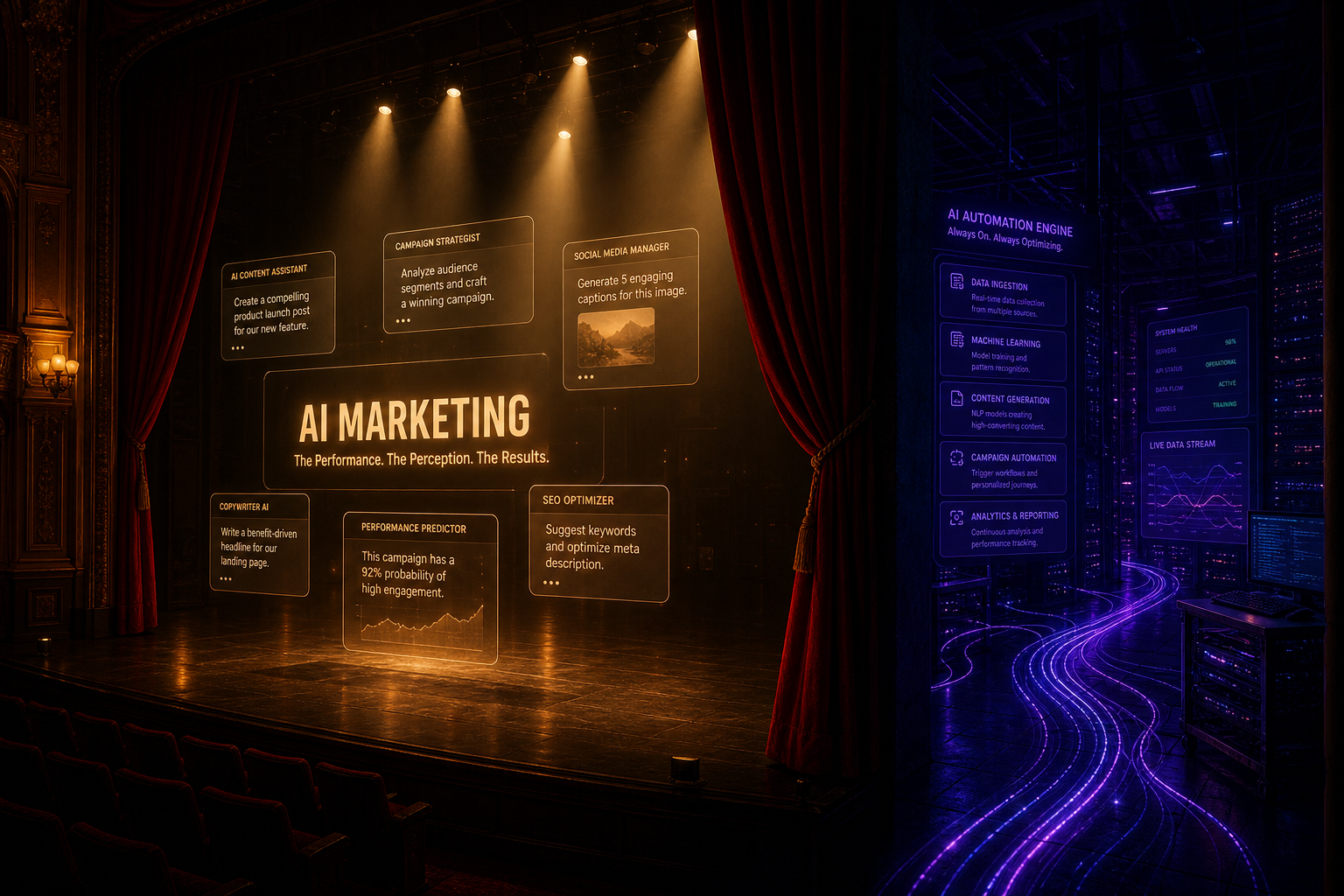
Using an AI writing tool to produce a blog post is not transformation. It's a faster keyboard. The underlying operation is identical to what you were doing before: plan the campaign, brief the content, prompt for the copy, copy-paste it into your CMS, manually schedule everything. You've replaced one part of the assembly line with a robot arm and left the rest of the factory untouched.
This is AI theater. It looks like AI adoption from the outside. It feels like AI adoption from the inside. But nothing about how your marketing actually runs has changed.
What AI theater looks like in practice
Walk through a typical "AI-powered" content workflow. A marketer (solo founder, one-person team, small marketing department) wants to publish a blog post.
Step 1: Open Claude. Write a prompt. Edit the output. Copy it into WordPress or Webflow.
Step 2: Open your email tool. Build the newsletter. Upload the HTML. Pick the segment. Schedule it manually.
Step 3: Open your social scheduler. Write a caption. Find an image. Queue it up.
Step 4: Repeat, on every channel, every week, forever.
AI shaved maybe 30 minutes off the writing. Everything else is exactly the same as 2020: the coordination, the execution, the scheduling, the tool-switching. The marketer is still the bottleneck at every step. The ceiling on output is still the number of hours in the day.
This is the core problem with AI theater: it optimizes one step in a multi-step process and calls it transformation. Saving 30 minutes on a task that took 3 hours is meaningful. But if you're still spending 40 hours a week executing marketing manually, you haven't transformed anything.
What AI transformation actually means
Real AI transformation in marketing isn't about who writes the blog post, or what writes it. It's about how your entire marketing operation runs.
The question to ask is not whether you're using AI to write content, but whether your marketing is actually happening differently, or whether it still depends on you personally executing every step.
A transformed marketing operation looks different in a few specific ways.
Planning is connected to execution. Campaign strategy, tasks, and deliverables live in one place. When you decide to launch a blog series, the tasks, the drafts, and the publishing schedule all flow from that decision. Not from you manually creating each piece and tracking it in a spreadsheet.
Execution actually happens. Emails go out. Posts get published. Workflows run. Without you manually triggering each one. The system moves because it's built to move, not because you pushed it.
The bottleneck shifts. In AI theater, the marketer is the bottleneck because every output requires manual effort. In AI transformation, the bottleneck is strategic: the limiting factor is the quality of your ideas and decisions, not your capacity to execute them.
Two marketers, two different realities
Both of these marketers describe themselves as "using AI in their marketing." Their actual situations are completely different.
Marketer A: AI theater
Sara runs marketing for a 15-person SaaS startup. She uses ChatGPT to write first drafts of everything: blog posts, email copy, LinkedIn content. She estimates it saves her about an hour a day.
But she still spends Monday morning figuring out what to write. She still manually formats and publishes each post. She still logs into her email platform to build and send every broadcast. She still schedules social posts one at a time. She's doing all the same work, just faster.
Last month, she got sick for a week. Marketing stopped entirely.
Marketer B: AI transformation
David runs marketing at a similar company. He uses an agentic marketing platform to manage his campaigns. He defines strategy and briefs (what audience, what message, what channel cadence) and the platform handles the execution layer.
Blog posts get written and drafted. Emails get built and scheduled. Social posts go out on time. When a campaign is set up, it runs. David's job is reviewing, refining, and deciding what's next, not manually producing every deliverable.
Last month, David took a week off. Marketing kept running.
Sara uses more AI tools than David does. David has more AI-first marketing than Sara does. The distinction matters.
Is using ChatGPT for marketing enough?
This is the question a lot of marketers are quietly asking. They've adopted AI writing tools. They're producing content faster. But they still feel like they're running on a treadmill, doing more but not getting ahead.
The honest answer: ChatGPT and Claude are writing tools. They're genuinely useful writing tools. But they're not a marketing system. They have no memory of your campaigns, no connection to your audience, no ability to send an email or publish a post or track what's working. They're a blank text box that produces text.
Using them is better than not using them. Calling it "AI-first marketing" overstates what they do.
AI-first marketing means your execution layer has fundamentally changed, not just your writing step. Campaigns are organized and tracked. Deliverables are created in context, connected to strategy. Emails and posts go out on schedule without manual effort. Performance data informs what happens next.
That's a different product category than a writing assistant. And it's the category that actually matters for small teams trying to compete with bigger ones.
What the path from theater to transformation looks like
The shift doesn't require abandoning the tools you already use. Claude and ChatGPT are useful. The question is what platform they feed into.
The upgrade is moving from: AI tool for content creation + manual everything else → AI platform where creation, execution, and tracking are connected.
In practice, that means:
Your campaign brief informs your content as persistent context the system uses across every deliverable, not as a prompt you write manually each time
Deliverables are created inside the system that publishes them, not in a chat window that has no connection to your CMS or email platform
Scheduling and execution happen automatically, not because you remembered to click publish
When you're not working, the marketing is
The distinction is systemic, not superficial. Real AI-first marketing isn't about who writes the blog post. It's about whether your marketing operation actually runs, or whether it only runs when you're running it.
Quotient is built for this
Quotient is the platform where AI-first marketing actually happens. Not just the writing step. The whole operation. Campaigns, deliverables, email sends, social publishing, workflows: all connected, all running, with agents that execute across every channel.
If your marketing only runs when you're running it, Quotient is built to change that.
Blog